
Audi presents its new digital OLED technology at world’s largest lighting congress

At the thirteenth International Symposium on Automotive Lighting (ISAL 2019), Audi presenters will offer insights into the next generation of OLED lighting technology.

The new digital OLED technology enables customizable lighting designs and permits communication using the exterior lighting. The congress begins on September 23, 2019 in Darmstadt. Audi guest speakers will be presenting digital OLED technology as well as the latest trends and developments in lighting at what is the biggest and most important conference for automotive lighting technology.

Audi’s OLED (organic light emitting diode) technology first went into series production in 2016 in the rear lights of the Audi TT RS. Unlike point light sources – such as LEDs which are made of semiconductor crystals – OLEDs are flat light sources. Their light attains a new level of homogeneity, and dimming is continuously variable. The lights do not cast any shadows, nor do they require any reflectors, light guides or similar optical components – and this makes the OLED units very efficient and lightweight. Another advantage of OLEDs is the scope for dividing them into small segments that can be energized to different levels of brightness. OLED lights can also produce animation effects in Audi models, such as coming home and leaving home scenarios.

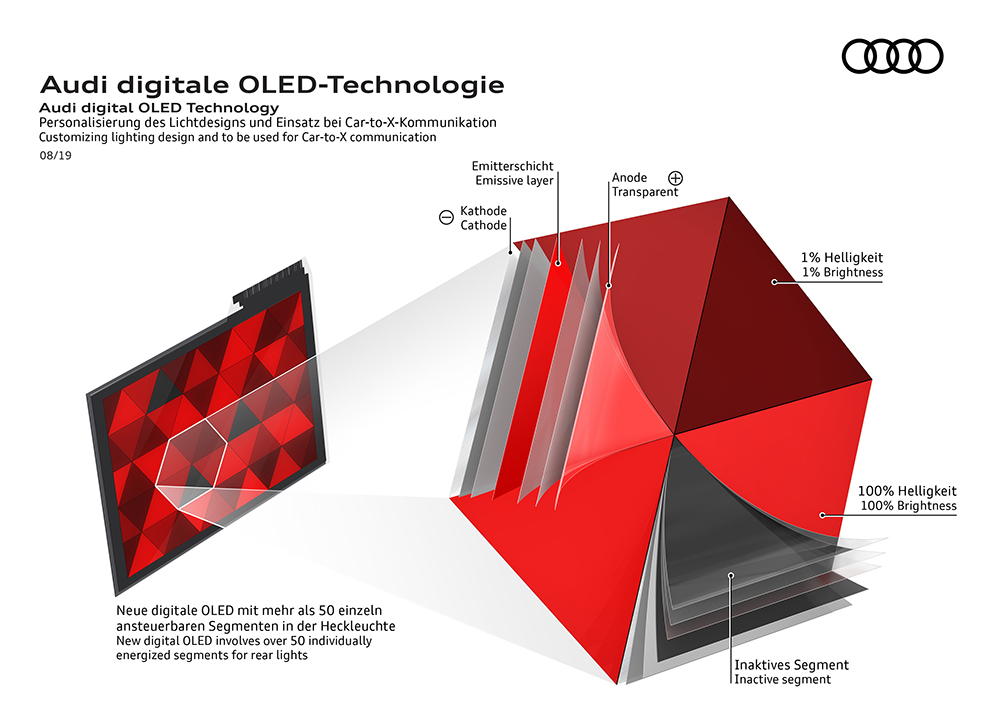
The next development stage – digital OLED technology – will be unveiled to the public at the ISAL. While previous Audi models have featured up to four freely designed complex light segments to realize a specific design, the new technology of digital OLED makes customizable lighting design possible for the rear lights.

This involves dividing the OLED light sources into a much greater number of individually energized segments. The resulting over 50 segments can be activated as needed and their brightness continuously adjusted. Audi designers and developers can thus produce a wide variety of lighting designs with the same hardware. The benefits of OLED include perfect contrast, high homogeneity and minimal spacing between segments. It maintains high system efficiency as a flat light inside a lighting element with a thickness of just one millimeter (0.04 in). Digital OLED is therefore the perfect technology for executing a highly precise and versatile form of customizable lighting design.

As well as the wide range of lighting designs possible, digital OLED can serve as a display element in the rear lights for car-to-x communication. Predefined symbols, for example, can be displayed to alert other road users promptly to local hazards such as black ice or the approaching end of a tailback.

Audi will be giving next-generation digital OLED technology its first showing in a demonstrator at the ISAL from September 23.

Suivez-nous :
SourceAudi
Articles connexes

213 km/h en drift : la Chine prend le...

La Hyptec SSR, hypercar électrique produite par GAC Aion, détient le record du drift à 213,52 km/h, prouvant les capacités techniques des constructeurs chinois face aux géants européens. Une avancée significative dans le secteur automobile.

Opel célèbre le 8 mars avec deux directrices des...

Opel célèbre la Journée internationale des droits des femmes en mettant en avant Maike Seeber et Bilyana Stern, deux dirigeantes qui innovent dans la production et le management chez Stellantis en Allemagne.

Citroën casse le prix de l’électrique en Suisse avec...

Citroën lance l'ë-C3 Urban Range à 18 990 francs en Suisse, ciblant les trajets urbains avec 204 km d'autonomie. Ce véhicule électrique d'entrée de gamme assure confort, praticité et production locale, rendant l'électrique accessible aux ménages suisses.

MXGP 2026 : Yamaha lance l’assaut pour le titre...

Le Championnat du Monde FIM Motocross 2026 débute en Argentine à Bariloche. Les équipes Yamaha, emmenées par Gajser, Renaux et les frères Reisulis, visent les titres grâce à un circuit inédit.

Top Actualité

480 km et nouvelle batterie : la Renault Mégane électrique passe un cap décisif

Renault annonce une mise à jour de la Mégane E-Tech Electric, prévue ce printemps. Avec une nouvelle chimie de batterie lithium-fer-phosphate et une autonomie dépassant 480 km, elle se dote d'un design sportif pour renforcer sa compétitivité sur le marché.

Dacia Striker (ex C-NEO) : le nom du futur crossover-break enfin révélé

Dacia a dévoilé le nom de son futur crossover, Striker, un break surélevé, qui vise à rivaliser avec des modèles comme l'Octavia Combi, tout en offrant un excellent rapport qualité/prix.

« Ensemble on va gagner » : la lettre d’Antonio Filosa à ses troupes révèle l’état réel de Stellantis

Antonio Filosa, PDG de Stellantis, a adressé une lettre franche sur les déceptions de 2025, reconnaissant les erreurs stratégiques et opérationnelles. Il annonce un « reset » nécessaire, axé sur l'exécution, et des premiers signes d'amélioration pour 2026.
Nouveautés

Ford Kuga 2026 reçoit BlueCruise mains libres en Europe

Ford intègre sa technologie BlueCruise de conduite semi-autonome au Kuga dès avril 2026, offrant un système mains libres sur plus de 135 000 kilomètres d'autoroutes en Europe, avec options tarifaires flexibles.

480 km et nouvelle batterie : la Renault Mégane électrique passe un cap décisif

Renault annonce une mise à jour de la Mégane E-Tech Electric, prévue ce printemps. Avec une nouvelle chimie de batterie lithium-fer-phosphate et une autonomie dépassant 480 km, elle se dote d'un design sportif pour renforcer sa compétitivité sur le marché.

Opel renouvelle la Corsa YES : une peinture Koral Orange exclusive et des options inédites dès 16 250 €

Opel présente la Corsa YES 2026, une citadine rafraîchie avec une peinture Koral Orange inédite, des packs optionnels abordables et deux motorisations, visant à séduire une clientèle jeune. Prix de départ : 16 250 €.
Articles Récents