
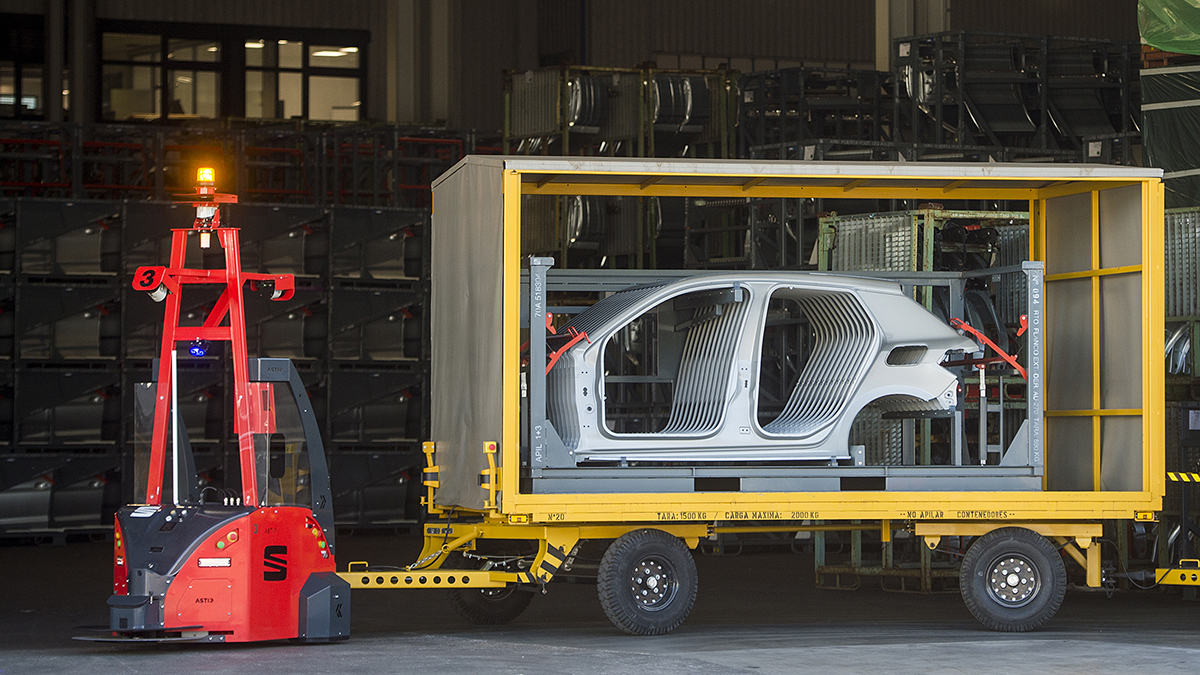
The SEAT plant in Martorell is making progress towards its goal of becoming a more sustainable, digitalised and smart factory.
SEAT is the first industrial manufacturer in Europe to have outdoor, automated guided vehicles with SLAM navigation (simultaneous localisation and mapping), 4G connection and induction battery charging. To date, eight AGVs are operating outside the production workshops at the Martorell plant to automate the transport of parts. The new vehicles join the 200 AGVs that are delivering parts inside the assembly workshops at the Martorell and Barcelona factories.
Each outdoor AGV and their carriages make up a 25-metre convoy with a maximum transport capacity of 10 tonnes and cover routes of 3.5 kilometres in length. Thanks to SLAM navigation, these vehicles are not guided by magnetic tape or wires, so maintenance costs are reduced, they are more versatile to adapt to new routes and their installation does not require any construction.
Altogether, the eight AGVs travel 240 kilometres a day. There are currently two ongoing routes between the press and metal shops on which vehicle side parts and mobile elements such as hatches and doors are delivered, a move which does away with truck transport between these facilities.
The fleet of outdoor AGVs enables a reduction of 1.5 tonnes of CO2 per year, since until now these deliveries were carried out using a truck and a tractor. The use of these AGVs makes deliveries more efficient and cost-effective, and reduces stockpiling at both the starting and destination points as well as vehicle traffic inside the factory. The project was developed in collaboration with ASTI Mobile Robotics and Telefónica.
SEAT Vice-president for Production and Logistics Dr. Christian Vollmer said that “in recent years SEAT has been introducing pioneering innovations in the field of logistics and this is another example of our commitment to becoming a benchmark for Industry 4.0. The implementation of outdoor AGVs enables us to optimise production and logistics processes in an efficient, sustainable and connected way.”
A benchmark for Industry 4.0
With this project, SEAT improves its efficiency and progresses towards its goal of making the Martorell plant a smarter factory through the Internet of Things in industrial environments where process automation and digitalisation is key. In recent years, SEAT has applied technological innovations to its entire production cycle, such as the AGVs themselves, which are integrated in the production line for transporting parts, the use of drones for urgent parts delivery and collaborative robots which, combined with more efficient data management thanks to the use of artificial intelligence, big data and blockchain, enable more efficient, flexible and agile processes. All of these 4.0 novelties coexist with the factory’s 7,900 workers, who currently turn out 2,300 vehicles daily.
📖 Lire aussi :
Cupra Raval 2026 : Pour 450 km d’autonomie, son prix est accessible et totalement inattendu !
