
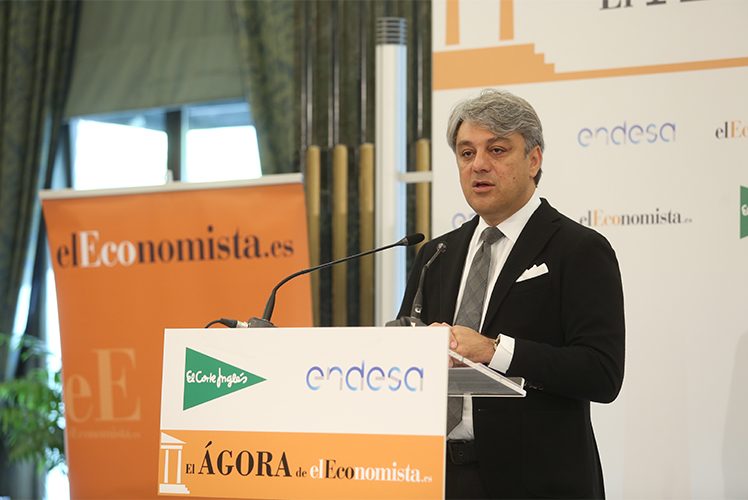
Luca de Meo gave a talk on innovation and industry trends at the elEconomista daily’s Agora conference

SEAT CEO Luca de Meo shared his views on the challenges facing the auto industry at an event held in Madrid, framed in the Ágora conference cycle organised by the daily elEconomista. This morning’s talk was moderated by elEconomista director Amador G. Ayora.

De Meo reiterated that SEAT is in the process of going from being a carmaker to becoming a mobility solution provider and highlighted that “over 100 years ago, the automotive industry put society on wheels. Now we find ourselves at an even more crucial point, and I am convinced that we have the necessary mindset, capability and commitment in order to emerge even stronger.” In addition, he pointed that “the achievements of the past should serve to motivate businesses and institutions to push progress forward and share prosperity with society in order to continue to evolve.”

With reference to the arrival of alternative energies and the electric car, the CEO of the company announced that “materials science is tackling the challenge of developing state of the art, affordable materials that will enable the electric car to extend and the definitive emergence of renewable energies.” De Meo underlined that SEAT recently presented its electric offensive, which includes six new electric and plug-in hybrid vehicles by both SEAT and CUPRA; and that the company is going to develop a new electric platform for urban cars together with the Volkswagen Group that “will be the basis for making electric vehicles affordable to a wider public – we aim to contribute to democratise sustainable mobility.”

The CEO of SEAT underscored one of the most ambitious projects in the scope of connectivity and artificial intelligence, namely the electric, autonomous car. “As soon as the technology and legislation are in place, the autonomous car will have the potential to reduce the cost of road transport by 90%.” De Meo also pointed out that it will help SEAT achieve its goal of zero accidents: “the connected autonomous car is going to make driving ten times safer by removing the human factor from the equation, which today is responsible for more than 90% of all traffic accidents.”

Finally, Luca de Meo talked about the importance of people, who are behind every technological revolution, and insisted that “we must invest in education and in training our workforce. In 10 years, 50% of our employees will be doing different jobs than today, and some of these don’t even exist currently.” For this reason, last year SEAT invested close to 23 million euros in training, the equivalent of 1,500 euros per employee, or 17 times more than the national average. “Helping our employees reinvent themselves is essential”, he concluded.

Suivez-nous :
Articles connexes

Auto Mobil Paris 2026 ouvre ses portes à la...

Le salon Auto Mobil Paris se déroulera du 30 avril au 11 mai 2026, présentant voitures, scooters et solutions de mobilité innovantes, avec un accent sur l'électrique et l'hybride, pour un public large.

Alfa Romeo bondit de 20 % en 2025 et...

Alfa Romeo a enregistré une hausse de 20,1 % de ses ventes en 2025, portée par le Junior. En Europe, la marque retrouve des parts de marché malgré la restructuration de Stellantis.

Lancia Corse HF de retour en ERC : l’Elefantino...

Lancia annonce son retour en compétition avec le Championnat d'Europe des Rallyes FIA 2026, engageant trois Ypsilon et se fixant des objectifs ambitieux après une victoire au Monte-Carlo.

272 ch : la Škoda Superb devient la plus...

La Škoda Superb, berline hybride rechargeable de 272 chevaux, surpasse la version précédente grâce à une puissance accrue, un couple amélioré et des performances renforcées, séduisant ainsi les familles et amateurs de berlines.

Top Actualité

480 km et nouvelle batterie : la Renault Mégane électrique passe un cap décisif

Renault annonce une mise à jour de la Mégane E-Tech Electric, prévue ce printemps. Avec une nouvelle chimie de batterie lithium-fer-phosphate et une autonomie dépassant 480 km, elle se dote d'un design sportif pour renforcer sa compétitivité sur le marché.

Dacia Spring 2026 gagne 100 ch et corrige ses défauts

Dacia modernise sa Spring 2026 avec de nouveaux moteurs, une batterie améliorée, et un châssis renforcé, tout en maintenant son prix compétitif pour rester leader des citadines électriques accessibles.
Nouveautés

Ford Kuga 2026 reçoit BlueCruise mains libres en Europe

Ford intègre sa technologie BlueCruise de conduite semi-autonome au Kuga dès avril 2026, offrant un système mains libres sur plus de 135 000 kilomètres d'autoroutes en Europe, avec options tarifaires flexibles.

480 km et nouvelle batterie : la Renault Mégane électrique passe un cap décisif

Renault annonce une mise à jour de la Mégane E-Tech Electric, prévue ce printemps. Avec une nouvelle chimie de batterie lithium-fer-phosphate et une autonomie dépassant 480 km, elle se dote d'un design sportif pour renforcer sa compétitivité sur le marché.

Opel renouvelle la Corsa YES : une peinture Koral Orange exclusive et des options inédites dès 16 250 €

Opel présente la Corsa YES 2026, une citadine rafraîchie avec une peinture Koral Orange inédite, des packs optionnels abordables et deux motorisations, visant à séduire une clientèle jeune. Prix de départ : 16 250 €.
Articles Récents