
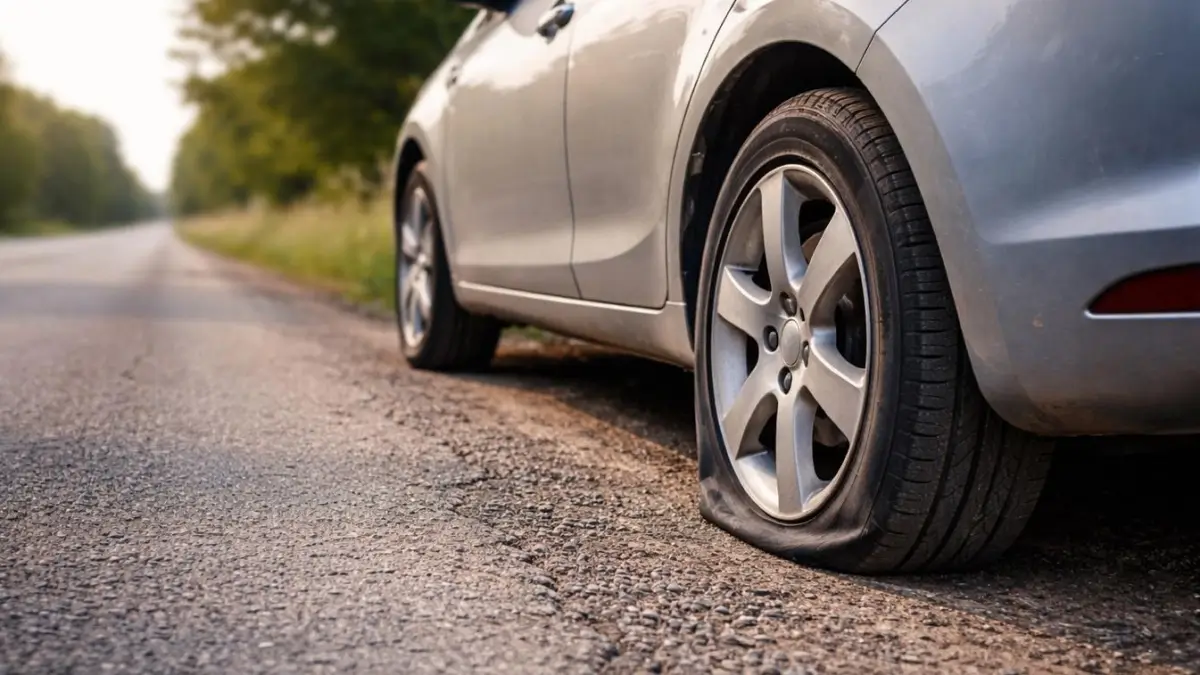
Run flat tire technology lets you keep driving after a puncture without stopping to change a tire on the side of the road. There are three main types: the self-supporting system, the support ring system, and the self-sealing system. Each uses a completely different engineering approach to solve the same problem, and choosing the wrong one for your situation could leave you stranded or spending more than necessary.
Why Run Flat Tires Exist in the First Place
A conventional tire relies entirely on pressurized air to hold the weight of your vehicle. When that air escapes, the tire collapses in seconds. You lose steering control, potentially veer into traffic, and face a mandatory roadside stop that is at best an inconvenience and at worst genuinely dangerous.
Run flat tires were engineered to break that dependency. Instead of collapsing when air pressure drops to zero, they use alternative structural elements, reinforced sidewalls, rigid internal rings, or chemical sealants, to temporarily keep the tire functional long enough to reach a repair shop safely.
📖 Lire aussi :
The technology is not new. Early experiments date back to the 1930s, but it was Michelin’s commercial development in the 1970s and 1980s that brought run flats to production vehicles. Today, over 60% of new vehicles in Europe are fitted with reinforced sidewall run flat tires as standard, and according to industry data, self-supporting designs account for roughly 61% of global run flat tire adoption.
Type 1: Self-Supporting Run Flat Tires
How the Technology Works
The self-supporting system is by far the most common type of run flat tire on the road. You will find it fitted as original equipment on BMWs, most Mercedes-Benz models, Teslas, and a wide range of other premium passenger cars.
The engineering principle is straightforward. In a standard tire, the sidewall is a thin, flexible structure that lets the tire flex and absorb road imperfections. In a self-supporting run flat, that sidewall is dramatically reinforced, typically 8 to 12mm thick according to engineering analysis, with heat-resistant rubber compounds, additional steel belt reinforcement, and a crescent-shaped insert of harder material embedded within the sidewall profile. Some designs incorporate aramid fibers, the same material used in Kevlar, to balance strength against weight.
When the tire loses air pressure, instead of collapsing, the rigid sidewall structure holds the tire’s shape and continues bearing the vehicle’s weight. The car remains driveable and steerable. You head for the nearest service center rather than the roadside gravel.
The 50/50 Rule You Must Know
Every self-supporting run flat has a published mobility limit. The industry-wide standard, confirmed by Bridgestone, BMW, Continental, and others, is 50 miles at no more than 50 mph after pressure loss. This is not a conservative buffer. It is an engineering limit based on heat accumulation testing.
When a tire runs deflated, the sidewall flexes far more than it normally would, generating heat through internal friction. Under normal inflation, air inside the tire acts as a heat sink. At zero pressure, that cooling mechanism is gone. At 70 mph, a tire rotates approximately 40% more times per mile than at 50 mph, generating proportionally more heat. Exceed the 50/50 limit and you risk irreversible internal structural damage without any visible external warning sign.
This raises a critical point: a deflated self-supporting run flat does not look flat. The stiff sidewall holds the car’s shape even at zero pressure, meaning you cannot identify the problem by eye. This is why every vehicle equipped with run flat tires is legally required to have a Tire Pressure Monitoring System (TPMS). In the United States, TPMS has been mandatory on all new passenger vehicles since 2007. The warning light on your dashboard is your only reliable indicator that the clock has started.
Trade-Offs
The reinforced sidewall that makes self-supporting tires work also makes them stiffer. More road imperfections filter through the tire to the suspension and into the cabin, resulting in a noticeably harsher ride compared to conventional tires. The design also carries a weight penalty of 20% to 40% over equivalent standard tires, which increases rolling resistance and can marginally reduce fuel economy.
Cost is the other significant consideration. Self-supporting run flats typically run 35% to 200% more than comparable conventional tires. After a deflation event, most manufacturers do not recommend repairing the tire because internal damage may not be visible on inspection. Replacement is generally the safer outcome, and this adds ongoing cost.
Type 2: Support Ring Run Flat Tires
How the Technology Works
The support ring system takes a fundamentally different mechanical approach. Rather than engineering strength into the tire sidewall itself, this system mounts a rigid ring of hardened rubber, composite polymer, or metal directly onto the wheel, inside the tire cavity.
Under normal driving conditions, the ring sits inside the tire and contributes nothing. Tires inflate normally, and there is no contact between tire and ring during regular operation. When air pressure drops, the deflating tire collapses onto the ring, which then bears the vehicle’s weight directly. The tire uses the ring as its structural support instead of either air or reinforced rubber.
Michelin’s PAX system, one of the most well-known implementations, uses this approach and specifies that a vehicle can travel up to 125 miles at 55 mph after a puncture. Support ring systems from other manufacturers can offer 100 miles or more of extended mobility, a significant improvement over the self-supporting standard.
Where You Find This Technology
Support ring systems are less common in everyday passenger vehicles and considerably less common in the aftermarket. You are more likely to encounter them in military vehicles, armored executive protection vehicles, government transport, and some high-specification commercial applications. Because the ring attaches to or is integrated with the wheel itself, support ring systems require purpose-built wheels. You cannot retrofit this system to a standard rim.
This design constraint, combined with higher manufacturing complexity and cost, is the primary reason support ring systems represent roughly 39% of the global run flat market compared to self-supporting’s 61%. The military and armored vehicle segment remains the core application, where the ability to sustain mobility under sustained hostile conditions, including bullet strikes, justifies the additional engineering.
Trade-Offs
Ride quality in support ring systems is generally better than in self-supporting designs because there is no need to stiffen the tire sidewall. The tire flexes normally under regular conditions, and the ring only comes into play during emergencies. The ability to handle heavier loads and travel longer distances after air loss is also a meaningful advantage in the applications where this system is deployed.
The disadvantages are the requirement for specialized wheels, higher overall system cost, and limited availability through mainstream tire retailers. For most private passenger car owners, access to replacement rings and compatible wheels makes this system impractical outside of OEM-equipped specialty vehicles.
Type 3: Self-Sealing Tires
How the Technology Works
Self-sealing tires operate on a completely different principle. Where self-supporting and support ring systems manage the situation after air has already escaped, self-sealing tires aim to prevent air loss from happening in the first place.
The inside of a self-sealing tire is coated with a layer of viscous sealant compound, typically a synthetic rubber-based gel, applied to the inner liner. When a nail, screw, or other sharp object punctures the tread, the sealant immediately flows into the hole, surrounds the foreign object, and seals it before significant air can escape. If the object is later removed, the sealant closes the hole again. In many cases, the driver is completely unaware a puncture has occurred because tire pressure never drops.
Unlike self-supporting run flats, self-sealing tires do not have reinforced sidewalls. They maintain the same flexible sidewall construction as conventional tires, which means ride quality is essentially identical to a standard tire.
Real-World Performance Data
Self-sealing technology from major manufacturers shows consistent performance in documented testing. Michelin’s SelfSeal technology, used on vehicles including the Ford Explorer, is rated capable of sealing approximately 90% of typical tread punctures. Continental’s ContiSeal seals holes up to 5mm in diameter and prevents around 80% of tread-area tire damage according to the manufacturer. Pirelli’s Seal Inside covers 85% of typical puncture causes.
The self-sealing tire market reflects the growing adoption of this technology. The global self-sealing tire segment was valued at approximately $20.76 billion in 2024 and is projected to reach $22.56 billion in 2025, with forecasts pointing to $47.73 billion by 2034. Electric vehicles have accelerated this adoption significantly, with Continental reporting it currently supplies self-sealing or run flat technology to nine out of ten electric vehicles as original equipment.
Critical Limitations You Need to Understand
Self-sealing tires are not run flat tires in the traditional sense. They prevent flats from happening, but they provide no extended mobility after a blowout or sidewall puncture. If a self-sealing tire suffers a puncture larger than roughly 6mm, or if the damage is to the sidewall rather than the tread, the sealant cannot close the gap. Air escapes, and the result is a conventional flat tire situation.
This distinction matters enormously when making a purchase decision. Self-sealing tires solve the nail-in-the-road problem almost invisibly, but they are not a substitute for self-supporting or support ring systems if your concern is continued mobility after a blowout or structural sidewall failure.
Side-by-Side Comparison
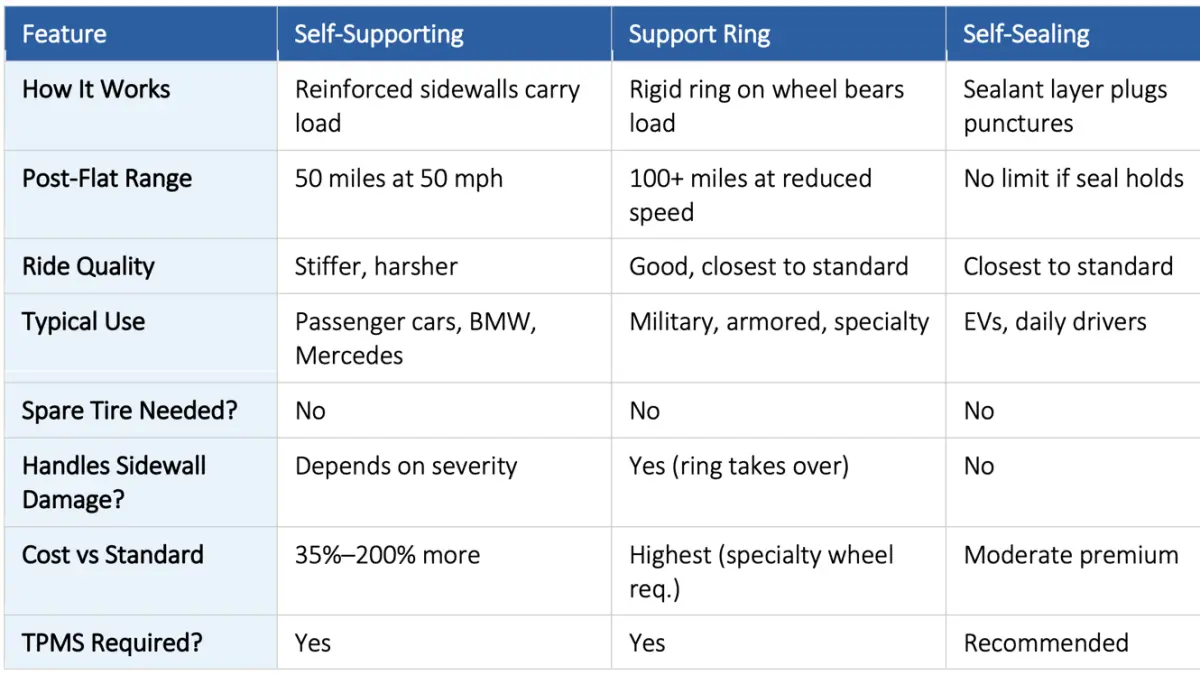
Here is how the three systems compare across the most important practical criteria:
How to Choose the Right Type for Your Vehicle
The right choice comes down to three questions: what vehicle you are driving, what kind of driving you do, and what problem you are most trying to solve.
- If your car came with run flats from the factory, you almost certainly have self-supporting tires and replacing them with the same system is the safest and most straightforward option. Check your sidewall for markings: RFT, SSR, ROF, or ZP typically indicate run flat specifications.
- If your primary concern is peace of mind against nail punctures on daily commutes, and you want no compromise in ride comfort, self-sealing tires are worth serious consideration, particularly if you drive an electric vehicle.
- If you drive an armored vehicle, a specialty commercial application, or operate in environments where extended post-puncture range is a safety-critical requirement, support ring systems are the appropriate choice, though they must be specified at the wheel level.
- If you drive a standard passenger car without TPMS and you are considering a run flat upgrade, note that both self-supporting and support ring systems legally require TPMS to function safely. Without it, you have no way of knowing you are operating outside the safe mobility window.
Frequently Asked Questions
Can you repair a run flat tire after it has been driven flat?
Most tire manufacturers recommend against repairing a self-supporting run flat that has been driven on while deflated. The internal structural damage from heat accumulation is typically invisible from the outside but can compromise the tire’s ability to provide extended mobility in a future event. When in doubt, replace rather than repair.
Do run flat tires need a spare tire?
No. One of the core benefits of run flat systems is that they eliminate the need to carry a spare. This frees up trunk space and reduces vehicle weight. Many vehicles factory-equipped with run flats ship without a spare tire or with only a tire inflation kit.
Are self-sealing tires the same as run flat tires?
No, and this confusion is extremely common. Self-sealing tires prevent air loss when small objects puncture the tread. They do not have reinforced sidewalls and cannot support the vehicle after a blowout or complete pressure loss. Run flat tires (self-supporting or support ring) allow continued driving after complete pressure loss. They solve different problems.
How long do run flat tires last compared to conventional tires?
Run flat tires generally last between 30,000 and 50,000 miles under normal driving conditions, comparable to many conventional tires, though some performance-oriented models may wear faster. The stiffer sidewall in self-supporting designs can accelerate tread wear in certain driving conditions. Major manufacturers including Bridgestone, Michelin, Goodyear, and Continental recommend inspection at four to six years regardless of remaining tread depth.
What speed can you drive on a run flat tire after a puncture?
The industry standard, confirmed by BMW, Continental, and Bridgestone, is no more than 50 mph. Bridgestone’s DriveGuard line is rated for 50 miles at 55 mph. Exceeding these limits accelerates heat buildup in the sidewall and risks catastrophic failure with no external visual warning.
Key Takeaways
- Self-supporting tires are the most widely used type, with reinforced sidewalls enabling 50 miles at 50 mph after pressure loss. They are stiffer, heavier, and more expensive than conventional tires but eliminate the need for roadside tire changes.
- Support ring systems use a rigid ring mounted inside the wheel to bear vehicle weight after air loss. They offer superior extended mobility (100+ miles) and better ride quality but require specialized wheels and are primarily found in military and specialty vehicles.
- Self-sealing tires use a viscous inner sealant to automatically plug tread punctures before air loss occurs. They ride like conventional tires but cannot handle blowouts or sidewall damage, and they are not run flat tires in the traditional sense.
- All three systems require TPMS for safe operation, as none of them visually sag when pressure is compromised.
- The self-sealing tire market is growing rapidly, projected to nearly double from $20.76 billion in 2024 to over $47 billion by 2034, driven largely by electric vehicle adoption.
Bottom Line
Run flat tire technology has advanced significantly since Michelin first commercialized it in the 1970s. Today, all three systems, self-supporting, support ring, and self-sealing, are engineered solutions to a real problem, but they are not interchangeable. The self-supporting system offers the best balance of availability, compatibility, and post-puncture mobility for most drivers. Self-sealing technology delivers the best ride quality and nearly invisible puncture protection for everyday commuters and EV drivers. The support ring system remains the choice for applications where maximum load capacity and extended range are non-negotiable safety requirements.
Before purchasing any run flat tire, confirm your vehicle’s TPMS functionality, check your owner’s manual for recommended passenger car tire type and specifications, and consult a certified tire specialist to verify compatibility. A tire that is not matched to your vehicle’s suspension tuning will underdeliver on both safety and comfort regardless of how good the underlying technology is. Ready to upgrade your tires? Speak with a certified tire specialist who can confirm which run flat system is compatible with your vehicle, your driving conditions, and your budget. Getting this right the first time is far cheaper than replacing the wrong tires twice.
En savoir plus sur MotorsActu
Subscribe to get the latest posts sent to your email.