
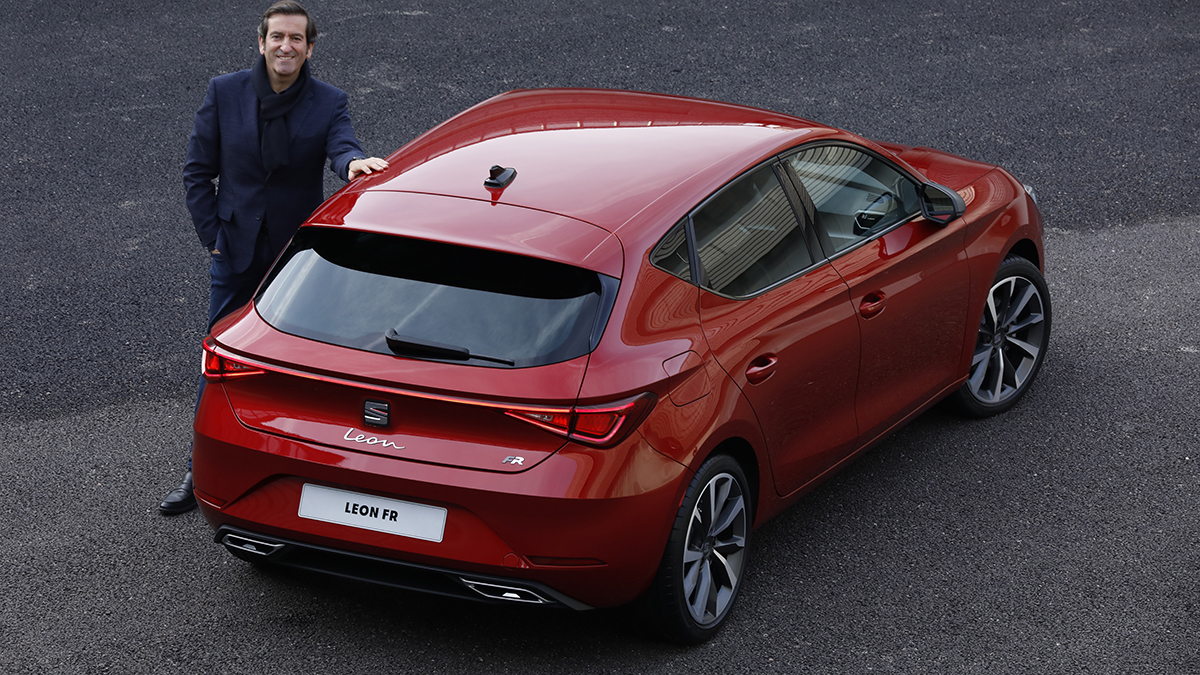
The curtain has come up. Taking centre stage was the new SEAT Leon 2020, shown to the world for the first time on 28 January in Martorell (Barcelona); a model that is all set to attract customers worldwide. What strengths will it use? Below we look at five of them.
Design: major evolution while preserving the essence. “Confidence, elegance and sportiness”. These are the attributes with which SEAT Design Director Alejandro Mesonero-Romanos defines his new creation. The exterior of the Leon is enhanced by improved proportions and a more defined front end, as well as softer lines. Meanwhile, the passenger compartment positions the driver and other occupants in the centre of the vehicle, with minimalism and elegance as its main features. In short, a new concept that preserves the DNA of the brand and of the three previous generations of the Leon.
Engines: wide range of the most advanced, efficient engines. This is a good way to describe the highly advanced engine range on the new Leon. There are petrol (TSI), Diesel (TDI), Compressed Natural Gas (TGI), micro hybrid or Mild-Hybrid (eTSI) and plug-in hybrid PHEV (eHybrid) versions. The goal is obvious: to offer customers efficient, varied and increasingly sustainable solutions.
📖 Lire aussi :
Le groupe Volkswagen n’exclut plus la disparition progressive de la marque SEAT après 2030
Totally connected. The new Leon is the first fully-connected SEAT vehicle. What does that mean? Inside the vehicle (Full Link including Android Auto and wireless AppleCarPlay) customers are guaranteed access to their digital lives no matter which device they use. Outside, the SEAT CONNECT app provides remote control of a host of functions to maximise comfort and safety. Added to this is the Digital Cockpit, which features a high-resolution 10.25 inch screen and a clear commitment to voice recognition.
More safety. Adaptive Predictive Cruise Control, Emergency Assist 3.0, Trip Assist, Side and Lane Assist. These are some of the most advanced systems that make the Leon the safest model ever created by the brand; a vehicle developed to have a broader view of its surroundings and react to road obstacles or the sudden movements of other drivers.
Lighting the way in the segment. The new Leon goes beyond the bounds of what is possible in terms of both exterior and interior lighting. Full LED technology in the headlights improves vision even on the darkest of roads, providing up to 900 lumens of light. And at the rear, the compact features lighting that runs across the entire width of the body for the first time. It also features welcome lights that project the greeting ‘¡Hola!’ on the ground when accessing the car. The interior keeps up with a wrap-around system that provides decorative ambient light as well as a series of functional highlights, such as indicators that warn of the presence of motorcycles approaching from the rear.