

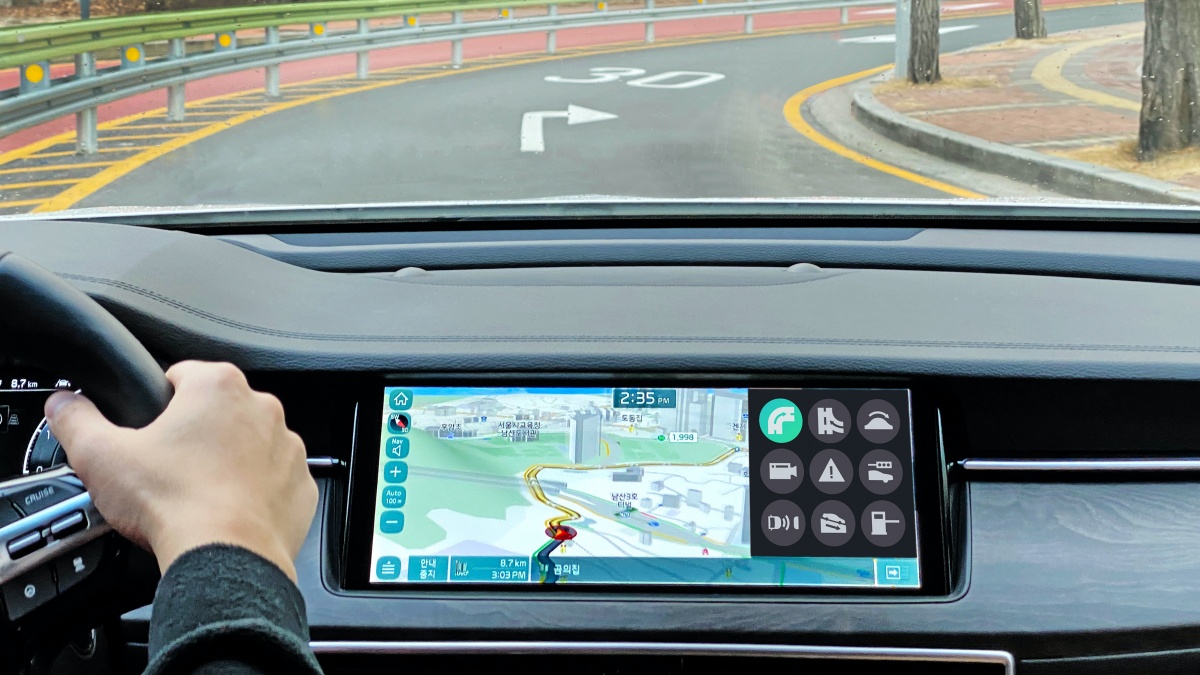
Hyundai Motor Company and Kia Motors Corporation announced today that they have developed the world’s first predictive Information and Communication Technology (ICT) Connected Shift System, enabling the vehicle to automatically shift to the optimal gear after identifying the road and traffic conditions ahead.
Hyundai and Kia plan to apply the technology on future vehicles. During system development, the companies filed about 40 major patents in South Korea and abroad.
While the technologies used to automatically shift depend on drivers’ preferences, such as Smart Drive Mode – available on most current Hyundai and Kia models – ICT Connected Shift System is the first ICT to automatically shift the gear according to road and traffic conditions.
ICT Connected Shift System uses intelligent software in the Transmission Control Unit (TCU) that collects and interprets real-time input from underlying technologies, including 3D navigation equipped with a precise map of the road as well as cameras and radar for smart cruise control. The 3D navigation input includes elevation, gradient, curvature and a variety of road events as well as current traffic conditions. Radar detects the speed and distance between the vehicle and others, and a forward-looking camera provides lane information.
Using all of these inputs, the TCU predicts the optimal shift scenario for real-time driving situations through an artificial intelligence algorithm and shifts the gears accordingly. For example, when a relatively long slow down is expected and radar detects no speed irregularities with the car ahead, the transmission clutch temporarily switches to neutral mode to improve fuel efficiency.
When Hyundai and Kia tested a vehicle with an ICT Connected Shift System on a heavily curved road, the frequency of shifts in cornering was reduced by approximately 43 percent compared to vehicles without the system. Accordingly, the system also reduced the frequency of brake operation by approximately 11 percent, thereby minimizing driving fatigue and brake wear.
When rapid acceleration was required to enter a highway, the driving mode automatically switched to Sport Mode at the merge, making it easier to join the traffic flow. After merging with traffic, the vehicle automatically returned to its original driving mode, enabling safe and efficient driving.
In addition, the engine brakes were automatically applied upon release of the accelerator pedal by determining speed bumps, downhill slopes and location of the speed limit change on the road. The changes in distance from the front car were detected by the front radar to adjust appropriate transmission gear automatically, which improved driving quality.
The system is also in line with autonomous technology, which is developing day by day. The ICT Connected Shift System will deliver both improved fuel efficiency and a stable driving experience in the era of autonomous vehicles by providing improved performance in response to real-time road and traffic conditions.
Hyundai and Kia are planning to further develop the ICT Connected Shift System into an even more intelligent transmission technology that can communicate with traffic signals based on LTE or 5G communication and identify drivers’ tendencies, resulting in further refinement of gear-shift control.
En savoir plus sur MotorsActu
Subscribe to get the latest posts sent to your email.
