
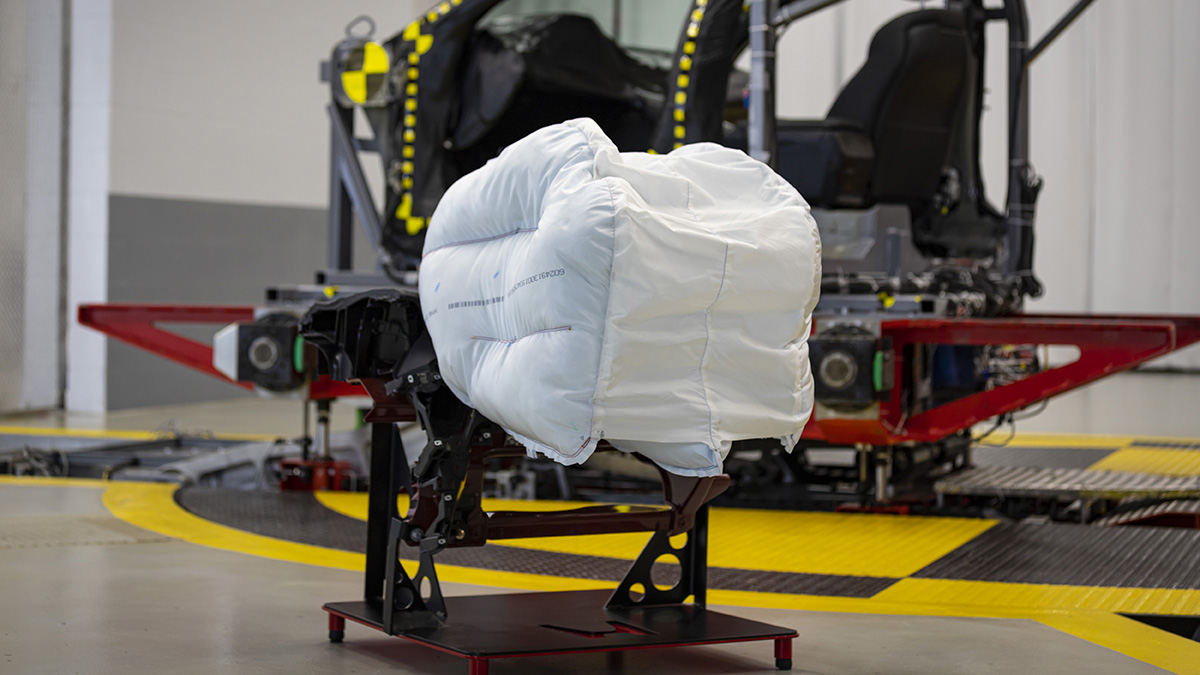
Honda today announced the development of an innovative new passenger front airbag technology designed to better protect occupants in a wide range of frontal collision scenarios, including angled crashes between vehicles or a vehicle and another object. Honda plans to begin applying its advanced airbag design to new products in North America in 2020.
Development and testing of the new airbag was led by engineers at Honda R&D Americas, Inc. in Ohio in partnership with Autoliv, one of the company’s safety systems suppliers. The new design is based on Honda’s commitment to developing technologies that better protect vehicle occupants in a wide range of crash scenarios.
In 2017, upwards of 37,000 people lost their lives on U.S. roadways as a result of motor vehicle traffic crashes, a slight decrease from the previous two years, according to data from the National Highway Traffic Safety Administration (NHTSA).
📖 Lire aussi :
Sur la Honda NT1100, deux acheteurs sur trois renoncent à la boîte de vitesses manuelle
“This new airbag technology represents Honda’s continuing effort to advance safety in a wider variety of crash scenarios and reflects the innovative thinking that our engineers are bringing to the challenge of reducing traffic injuries and fatalities,” said Jim Keller, President of Honda R&D Americas, Inc. “Guided by Honda’s ‘Safety for Everyone’ commitment, our engineers recognize that their work on this type of breakthrough safety technology will have far-reaching effects on peoples’ lives for many years to come.”
New Airbag Design
Honda’s next-generation airbag is designed to reduce the potential for injuries that can occur in a wider variety of frontal impacts. It is particularly beneficial in angled frontal impacts in which lateral collision forces can cause an occupant’s head to rotate severely or slide off the airbag, increasing the chance of serious injury.
Unlike conventional airbag systems that rely on a single inflatable compartment, the new system utilizes four major components: three inflated compartments — a centre chamber and two outward-projecting side chambers that create a wide base across the dash — along with a “sail panel” that stretches between the two side chambers at their outermost edge. Operating something like a baseball catcher’s mitt, the sail panel catches and decelerates the occupant’s head while also engaging the side chambers, pulling them inward to cradle and protect the head, mitigating the potential for injury.
This next-generation airbag technology is the result of Honda engineers’ study of real-world crash events along with research and testing conducted at the company’s advanced safety research center in Raymond, Ohio. Honda’s Ohio safety centre is one the most sophisticated facilities for safety research, development and testing in the world and includes facilities dedicated to advanced crash simulations, pedestrian safety, collision testing and advanced restraint system development and tuning.
Honda Safety Leadership
Honda also is working to develop and deploy advanced passive safety and active safety systems that can reduce the severity of a collision or help avoid it entirely. In addition to passive safety systems such as airbags, seatbelts and advanced crash safety structures like the company’s Advanced Compatibility Engineering™ (ACE™) body structure, Honda is aggressively deploying its Honda Sensing® and AcuraWatch™ suites of safety and driver-assistive systems. Today, more than 2.5 million vehicles on U.S. roadways are utilizing these technologies, which are now standard or available on all 2019 and newer Honda models and standard on all 2019 and newer Acura sedans and SUVs. The company has committed to making this broad suite of technologies standard on nearly all of its vehicles by 2022.
Combined, Acura and Honda have ten 2019 model-year vehicles in the U.S and Canada – Acura: MDX, RDX1 and RLX; Honda: Accord, HR-V2, Insight, CR-V2, Odyssey,2 Pilot and Ridgeline — that earned a TOP SAFETY PICK or TOP SAFETY PICK+ rating from the Insurance Institute for Highway Safety (IIHS) in the U.S. Further, all 2019 model-year Acura and Honda vehicles that have been fully tested in the U.S. by the National Highway Traffic Safety Administration (NHSTA) have earned a top 5-star Overall Vehicle Score, 15 model nameplates in total.
Honda Safety for Everyone Commitment
As a manufacturer of a wide variety of products including automobiles and powersports vehicles, Honda’s “Safety for Everyone” commitment is not limited only to the needs of car drivers and motorcycle riders, but extends to passengers, pedestrians, and occupants of all vehicles — in short, to everyone sharing the road. On the basis of this “Safety for Everyone” concept, Honda is committed to developing innovative safety technologies and equipping them to its automobiles, motorcycles and other powersports products toward Honda’s vision for a collision-free mobile society where its customers, and everyone sharing the road, can safely and confidently enjoy the freedom of mobility.
About Honda Safety Leadership
Based on its “Safety for Everyone » approach, Honda has a long history of leadership in the development and application of advanced technologies designed to enhance the safety of all road users, including automobile occupants, motorcycle riders and pedestrians.
Toward Honda’s goal of a “zero-collision society,” the company is broadly applying active safety and driver-assistive systems such as Honda Sensing® and AcuraWatch™. These technologies can significantly reduce the likelihood or severity of a collision and also serve as a bridge to highly automated vehicles of the future. Honda is targeting 2020 for the deployment of vehicles with highly automated highway driving capability and 2025 for the technological achievement of SAE Level 4 automated vehicles for personal use.
About Honda R&D
Operating 14 facilities in the United States, Honda R&D Americas, Inc. (HRA) was incorporated in 1984 after beginning operations in California in 1975. HRA is responsible for creating advanced products and technologies that provide new value to Honda and Acura customers. HRA conducts all phases of product development in the U.S., from market and technology research and styling through engineering design to prototype fabrication and testing, local parts procurement and support for mass production preparation.
With major facilities in California, Ohio, North Carolina and Florida, HRA is engaged in the development of Honda and Acura automobiles and Honda powersports and power equipment products. HRA is also playing a lead role in the development of leading-edge safety, driver assistive and environmental technologies.